
You thought the hardest part was over when you signed those papers. You imagined that once the legal battles ended and the dust settled, you’d simply… move on. But here you are, three months (or maybe three years) later, feeling like you’re on an emotional roller coaster that no one warned you about. One day you’re confident and excited about your new life, and the next you’re crying in the grocery store cereal aisle for reasons you can’t even explain.
If this sounds familiar, take a deep breath. You’re not broken, and you’re not doing divorce “wrong.” The emotional phases after divorce are far more complex, unpredictable, and layered than anyone tells you. Unlike the neat stages of grief you might have read about, healing from divorce doesn’t follow a tidy timeline or a predictable path.
Key Takeaways
• Emotional phases after divorce aren’t linear – you might experience multiple phases simultaneously or cycle back through earlier emotions unexpectedly
• There’s no “normal” timeline – your healing journey is uniquely yours, whether it takes months or years
• Setbacks and confusion are part of the process – feeling stuck or emotionally inconsistent doesn’t mean you’re failing at recovery
• Small, quiet moments often hold the biggest breakthroughs – healing happens in everyday experiences, not just dramatic revelations
• Your emotional experience is valid regardless of who initiated the divorce or what others think you “should” feel
The Myth of Linear Healing

Before we dive into the actual emotional phases after divorce, let’s address the elephant in the room: the myth that healing happens in a straight line.
Popular culture loves to paint divorce recovery as a neat progression from devastation to empowerment. You know the story – you start broken, go through some predictable stages, maybe have a makeover montage, and emerge as a stronger, better version of yourself. Roll credits.
Real life? It’s messier than that. Much messier.
Sarah, a teacher from Ohio, put it perfectly when she told me: “I thought I was ‘over it’ after six months. I was dating, I felt confident, I even helped a friend through her divorce. Then one random Tuesday, I found our old wedding album in a box and sobbed for three hours. I felt like I was back at square one.”
The truth is, emotional phases after divorce overlap, repeat, and surprise you. You might feel empowered on Monday, nostalgic on Tuesday, angry on Wednesday, and hopeful again by Friday. This isn’t a sign that you’re regressing – it’s a sign that you’re human.
Why We Expect Linear Healing
Our society loves progress that can be measured and milestones that can be checked off. We apply this thinking to everything from career advancement to fitness goals, so naturally, we expect emotional healing to work the same way.
But emotions don’t follow project management principles. They’re influenced by:
- Hormonal fluctuations 🌙
- Seasonal changes
- Random triggers (a song, a smell, a place)
- Life stressors unrelated to your divorce
- Sleep quality and physical health
- Social interactions and support levels
Understanding this helps normalize the emotional chaos you might be experiencing.
The Hidden Emotional Phases After Divorce
Let me walk you through the emotional phases that most people experience but rarely discuss openly. Remember, these aren’t steps on a ladder – they’re more like rooms in a house that you might visit in any order, sometimes all in the same day.
Phase 1: The Paperwork Relief (And Its Aftermath)
What it feels like: A strange mix of relief, numbness, and “now what?” confusion.
This phase often catches people off guard because it doesn’t match what they expected to feel. Whether you initiated the divorce or not, there’s often a moment of relief when the legal process is finally over. The constant stress of court dates, lawyer meetings, and document signing has ended.
But then comes the quiet.
“I remember sitting in my car after leaving the courthouse,” shares Michael, a father of two from Texas. “I thought I’d feel sad or angry or something dramatic. Instead, I just felt… empty. Like I’d been holding my breath for two years and suddenly didn’t know how to breathe normally.”
What’s really happening: Your nervous system is coming down from months or years of high-stress functioning. This emotional flatness isn’t depression (though it might feel like it) – it’s your body’s way of protecting you while you adjust to a new reality.
Common experiences in this phase:
- Feeling disconnected from your emotions
- Difficulty making simple decisions
- Physical exhaustion despite not doing much
- Confusion about what you actually want
- Relief mixed with unexpected sadness
Phase 2: The Identity Scramble
What it feels like: Looking in the mirror and not recognizing the person staring back.
This phase can hit weeks or months after the divorce is finalized. You start to realize that you’ve been half of a couple for so long that you’re not sure who you are as an individual anymore.
“I stood in the coffee shop for ten minutes trying to remember how I liked my coffee,” laughs Jennifer, a marketing professional from California. “I’d been ordering ‘his usual and a latte’ for so long that I couldn’t remember if I even liked lattes or if that was just… convenient.”
What’s really happening: You’re rediscovering your individual preferences, values, and desires. This is actually healthy work, even though it feels disorienting.
The identity scramble shows up in unexpected ways:
- 🤔 Forgetting what TV shows you actually enjoy
- 🛒 Standing in stores unsure what to buy for yourself
- 👥 Not knowing how to introduce yourself at social events
- 🏠 Feeling lost in your own living space
- 📱 Realizing your social media reflects a person you’re not sure you are anymore
Phase 3: The Emotional Whiplash
What it feels like: Experiencing contradictory emotions so quickly it makes your head spin.
This is perhaps the most confusing of all the emotional phases after divorce. You might miss your ex-spouse intensely in the morning and feel grateful for your freedom by evening. You could feel proud of your independence while simultaneously grieving the loss of partnership.
The emotional whiplash might include:
| Morning Emotion | Evening Emotion | Your Brain’s Response |
|---|---|---|
| Missing companionship | Loving the quiet house | “Am I crazy?” |
| Feeling lonely | Feeling relieved | “What do I actually want?” |
| Regretting the divorce | Remembering why you left | “Did I make a mistake?” |
| Wanting them back | Feeling angry about the past | “I’m so confused” |
“I called my sister crying because I missed him, then called her back two hours later angry that I’d wasted tears on someone who hurt me,” shares Lisa, a nurse from Florida. “She just said, ‘Honey, you can miss someone and still know they were wrong for you.’ That helped me realize I wasn’t losing my mind.”
What’s really happening: You’re processing multiple losses simultaneously – the loss of the relationship, the loss of your shared future, the loss of daily companionship, and the loss of your coupled identity. It makes perfect sense that you’d have multiple, sometimes conflicting feelings about all of these losses.
Phase 4: The Comparison Trap
What it feels like: Constantly measuring your progress against others and finding yourself lacking.
Social media makes this phase particularly brutal. Everyone else seems to be “winning” at divorce – they’re traveling, dating, thriving, glowing up, while you’re still figuring out how to cook dinner for one without crying.
Common comparison thoughts:
- “She’s already in a new relationship and seems so happy”
- “He bought a new house while I’m still in this apartment”
- “Everyone else seems to have figured out co-parenting”
- “My friend was over her divorce in six months”
- “I should be further along by now”
“I unfollowed my ex on Instagram, but then I started comparing myself to other divorced people I knew,” admits David, a teacher from Oregon. “I was keeping score of who was ‘winning’ divorce, which is insane when you think about it.”
What’s really happening: You’re looking for external validation that you’re healing “correctly” because the internal experience is so chaotic. But everyone’s divorce story is different – different relationship length, different reasons for ending, different support systems, different financial situations, different children involved.
Phase 5: The Unexpected Grief Waves
What it feels like: Being hit by intense sadness at random moments, often triggered by seemingly unrelated things.
This phase can be the most surprising because the grief doesn’t always make logical sense. You might be completely fine until you see a couple holding hands, hear a certain song, or realize you need to change your emergency contact information.
Unexpected grief triggers:
- 🎵 Songs that played during happier times
- 🏪 Places you used to go together
- 📅 Anniversaries and holidays
- 👨👩👧👦 Seeing happy families
- 📺 TV shows or movies you watched together
- 🍕 Ordering food and automatically thinking “he doesn’t like mushrooms”
“I was doing great until I went to update my passport,” shares Maria, a consultant from New York. “Changing my name back felt like erasing a whole chapter of my life. I cried in the post office, which was embarrassing but also somehow necessary.”
What’s really happening: Grief isn’t just about missing the person – it’s about mourning all the small, daily intimacies that made up your shared life. Your brain is literally rewiring itself to stop automatically including another person in your thoughts and plans.
Understanding the Emotional Chaos
Here’s what I wish someone had told me about the emotional phases after divorce: they’re not supposed to make sense.
Your brain is doing incredibly complex work right now. It’s:
- Processing the end of a significant relationship
- Adjusting to new daily routines
- Rebuilding your sense of identity
- Managing practical life changes
- Dealing with social and family dynamics
- Planning for an uncertain future
No wonder you feel emotionally scattered sometimes.
The Overlap Reality
Unlike the famous “five stages of grief,” divorce emotions don’t happen in sequence. You might experience:
Simultaneous emotions:
- Relief AND sadness
- Anger AND missing them
- Excitement AND fear
- Hope AND grief
- Freedom AND loneliness
Cycling emotions:
- Feeling “over it” one week, devastated the next
- Having good months followed by difficult periods
- Processing the same issues multiple times at deeper levels
Delayed emotions:
- Feeling numb initially, then experiencing intense emotions months later
- Thinking you’ve processed something, only to discover new layers
- Having emotional reactions to events that happened years ago
Why This Happens
Your emotional system isn’t broken – it’s actually working exactly as designed. Here’s the science behind the chaos:
Neuroplasticity: Your brain is literally rewiring itself. Neural pathways that automatically included your ex-spouse in every decision are being pruned and new pathways are being formed. This process takes time and energy.
Attachment system: Humans are wired for attachment. Even if your marriage was unhappy, your attachment system doesn’t just switch off because you signed papers. It needs time to adjust.
Stress response: Divorce is one of life’s most stressful experiences. Your stress response system affects everything from sleep to decision-making to emotional regulation.
The Phases No One Mentions
Beyond the obvious emotional phases after divorce, there are some experiences that people rarely discuss but are incredibly common:
The “Did I Make a Mistake?” Phase
Even if you initiated the divorce, even if you know it was the right decision, you’ll probably have moments of doubt. This doesn’t mean you made a mistake – it means you’re human.
“I knew leaving was right, but that didn’t stop me from wondering ‘what if’ during the hard moments,” shares Rebecca, a graphic designer from Colorado. “My therapist told me that questioning big decisions is normal and healthy. It means you take commitment seriously.”
The “I Don’t Know How to Be Alone” Phase
If you were in a long-term marriage, you might have forgotten how to be alone with yourself. This can feel scary, but it’s also an opportunity.
Learning to be alone again involves:
- Rediscovering what you enjoy when no one else is around
- Sitting with uncomfortable emotions instead of distracting yourself
- Making decisions based solely on your preferences
- Finding comfort in your own company
- Creating new routines that serve only you
The “Everyone Else Seems Coupled” Phase
Suddenly, it feels like every movie, every restaurant, every social event is designed for couples. You start noticing pair-oriented language everywhere: “bring your spouse,” “couples massage,” “party of two.”
This phase can make you feel like you’re living in a world that wasn’t designed for you. The good news? It passes as you start building a life that fits your new reality.
The “I’m Different Now” Phase
You might notice that you react differently to things, have different priorities, or find that relationships with friends and family have shifted. This can be unsettling, but it’s often a sign of growth.
“My friends kept expecting me to be the same person I was before,” explains Tom, an engineer from Michigan. “But I wasn’t. The divorce changed me – mostly for the better, but change is still change. It took time for everyone to adjust to the new version of me.”
Navigating the Emotional Maze
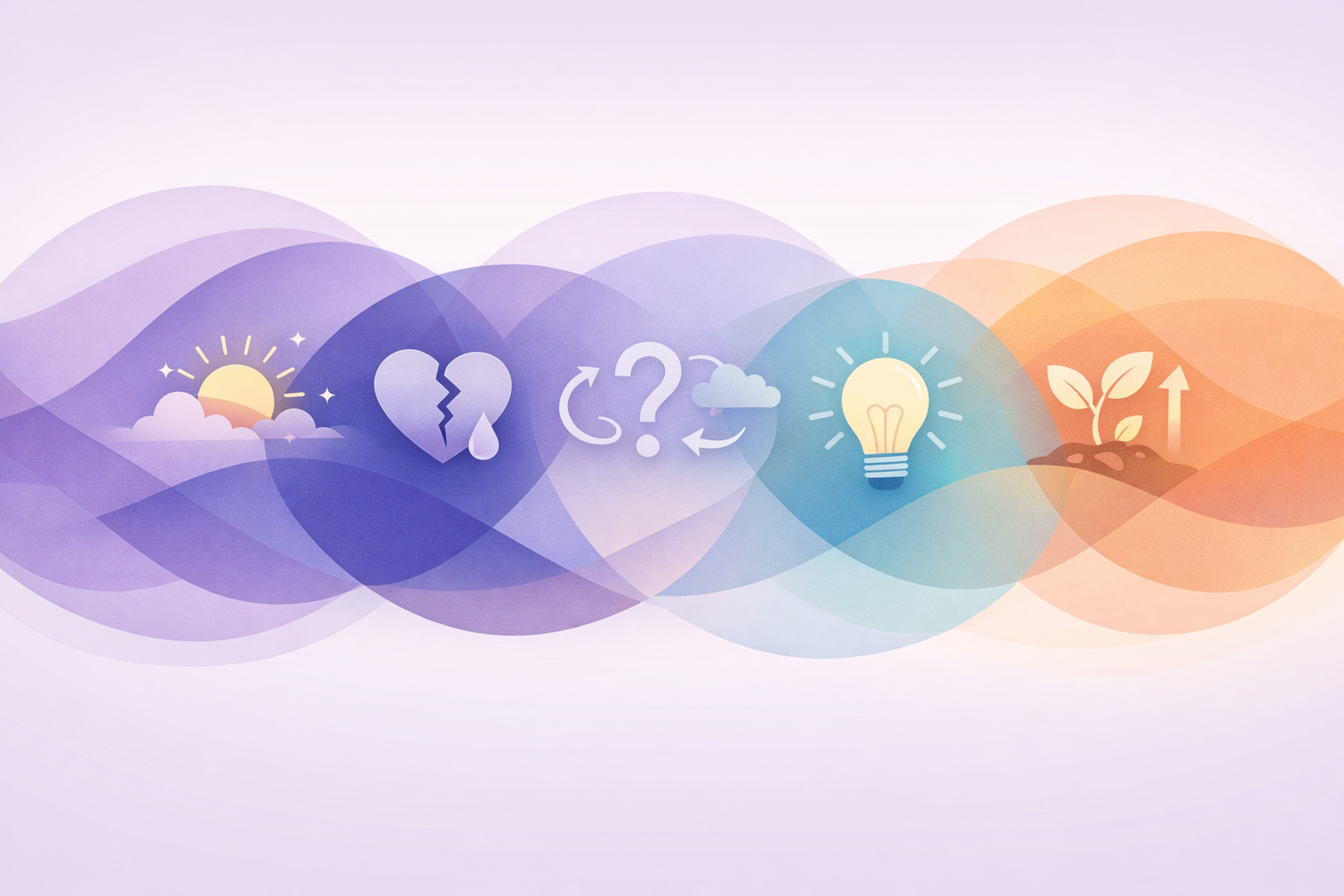
So how do you navigate these emotional phases after divorce without losing your mind? Here are some strategies that actually work:
1. Normalize the Chaos
Stop fighting the emotional inconsistency. Instead of thinking “I shouldn’t feel this way” or “I should be over this by now,” try thinking “This is what healing looks like for me right now.”
2. Track Patterns, Not Progress
Keep a simple emotion log – not to judge yourself, but to notice patterns. You might discover that you feel worse on Sundays (when you used to do family activities) or better after exercise or phone calls with certain friends.
3. Create Micro-Routines
When everything feels chaotic, small consistent routines can be anchoring. This might be:
- ☕ The same morning coffee ritual
- 🚶♀️ A daily walk around the block
- 📖 Reading for 10 minutes before bed
- 🎵 Playing the same calming playlist during difficult moments
4. Practice Emotional Granularity
Instead of just feeling “bad” or “good,” try to identify specific emotions. Are you feeling lonely, or disappointed, or overwhelmed, or nostalgic? The more precisely you can name your emotions, the better you can respond to them.
5. Build a Support Network That Gets It
Not everyone will understand your emotional journey. Seek out people who:
- Don’t rush your healing process
- Validate your feelings without trying to fix them
- Share their own struggles honestly
- Support your growth without judgment
This might include:
- Divorce support groups (online or in-person)
- Therapy with someone who specializes in life transitions
- Friends who’ve been through divorce
- Online communities where you can share anonymously
When to Seek Additional Support
While emotional chaos is normal during divorce recovery, there are times when professional support can be incredibly helpful:
Consider therapy if you’re experiencing:
- Persistent thoughts of self-harm
- Inability to function in daily life for extended periods
- Substance abuse as a coping mechanism
- Complete social isolation
- Inability to care for your children effectively
- Panic attacks or severe anxiety
- Depression that interferes with work or relationships
Remember: Seeking help isn’t a sign of weakness. It’s a sign that you’re taking your healing seriously.
The Light at the End of the Tunnel
Here’s what I want you to know about the emotional phases after divorce: they do shift and change. The intensity lessens. The confusion clears. The good days become more frequent than the bad ones.
But this doesn’t happen on anyone else’s timeline. It happens on yours.
“I’m two years out now,” shares Patricia, a librarian from Arizona. “I still have moments of sadness about my marriage ending, but they’re gentler now. And they’re mixed with so much gratitude for the life I’ve built. I couldn’t have imagined feeling this content when I was in the thick of it.”
Signs You’re Moving Through the Phases
You’ll know you’re progressing when:
- 🌅 You have more good days than bad days
- 🤔 You can think about your ex without intense emotional reactions
- 🎯 You start making plans based on what you want, not what you think you should want
- 😊 You enjoy your own company
- 💪 You handle setbacks with more resilience
- 🔮 You feel curious about your future rather than afraid of it
- ❤️ You can see the relationship’s end as sad but necessary rather than catastrophic
The Unexpected Gifts
Many people discover unexpected gifts in the emotional phases after divorce:
Emotional resilience: You learn that you can survive difficult emotions and come out stronger.
Authentic self-knowledge: Stripping away the couple identity reveals who you really are underneath.
Deeper empathy: Going through emotional chaos makes you more compassionate toward others’ struggles.
Appreciation for simple joys: Small pleasures become more meaningful when you’ve been through difficult times.
Stronger boundaries: You learn to protect your energy and emotional well-being.
If you’re starting to recognize where you are in these emotional phases, the next gentle step isn’t to rush forward — it’s to learn how to release some of the emotional weight safely.
👉 You may want to read: How to Let Go of Emotional Pain After Divorce Without Forcing It— because letting go isn’t about forcing yourself to stop caring. It’s about learning how to soften the grip without hurting yourself in the process.
Conclusion
The emotional phases after divorce are not a problem to be solved – they’re an experience to be lived through with as much compassion and patience as you can muster. Your healing journey won’t look like anyone else’s, and that’s exactly as it should be.
Some days you’ll feel like you’re making progress. Other days you’ll feel like you’re moving backward. Both are normal. Both are part of the process. Both are leading you toward a version of yourself that you might not be able to imagine yet but that you’ll be grateful to become.
Your next steps:
- Give yourself permission to feel whatever you’re feeling without judgment
- Reach out for support when you need it – whether that’s friends, family, or professional help
- Create small routines that anchor you during chaotic emotional periods
- Trust the process even when it feels messy and unpredictable
- Remember that healing isn’t linear – setbacks don’t mean you’re failing
You’re not broken. You’re not doing divorce wrong. You’re not taking too long to heal. You’re exactly where you need to be in your unique journey through the emotional phases after divorce.
And one day – maybe sooner than you think – you’ll look back on this time with gratitude for how it shaped you into someone stronger, wiser, and more authentically yourself than you ever thought possible.


